Possibly, in some situations, but the evidence is early and mixed. A few small trials suggest creatine may help short-term memory or reasoning, and one small study found gains during a night without sleep. Results for other kinds of thinking conflict.
Creatine has long been a gym staple. The newer claim is that it does something similar for the brain: that it helps the brain, one of the body's most energy-hungry organs, keep up with demand. The idea is plausible. The proof is thin.
What is creatine, and why would it matter to the brain?
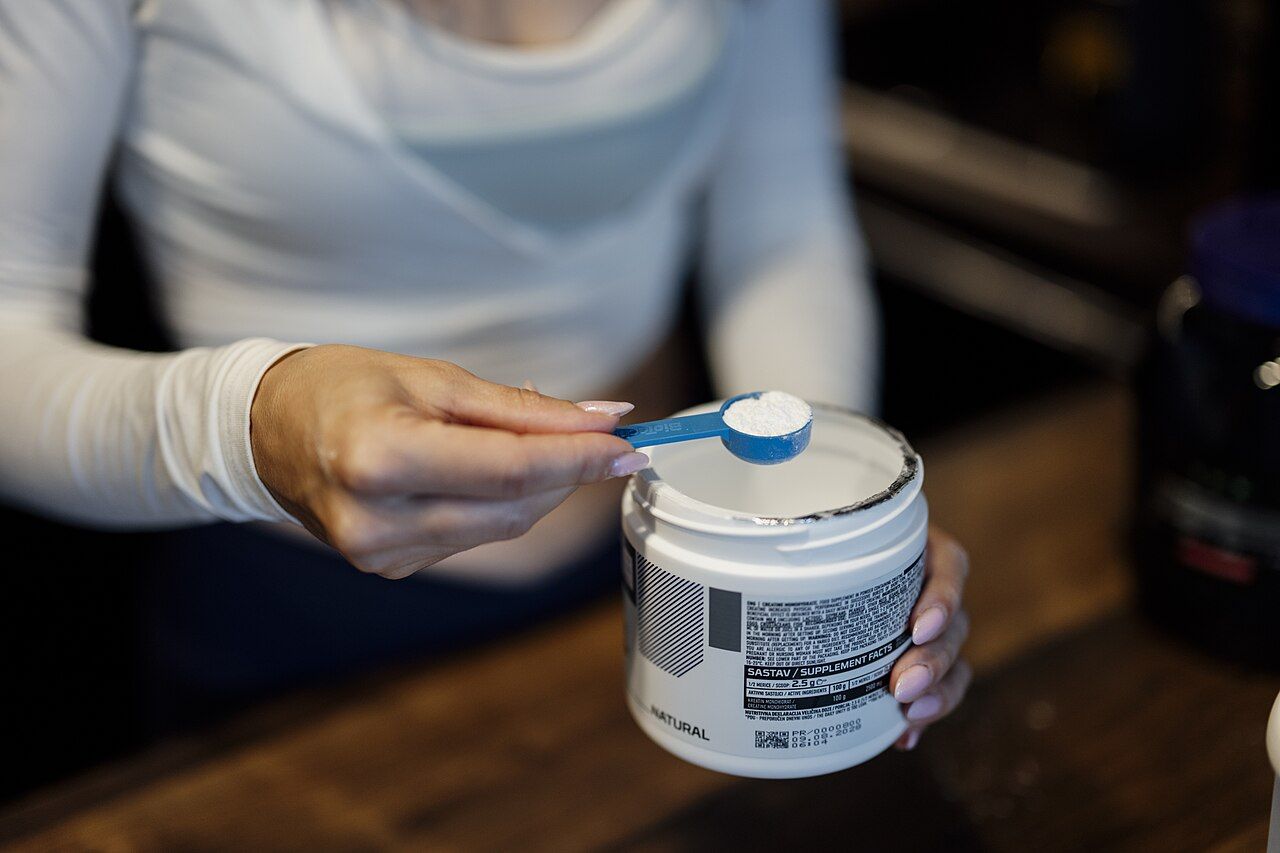
Creatine is a compound the body makes from amino acids, mostly in the liver and kidneys. It is also found in meat and fish. About 95 percent of the body's supply sits in skeletal muscle, with small amounts in the brain and testes, according to the International Society of Sports Nutrition.
Its job is to help recycle ATP, the molecule cells use as immediate fuel. Muscles use it for short bursts of effort. Brain cells also run on ATP, and the brain is an energy-hungry organ. That overlap is the mechanism behind the interest: more available creatine could, in theory, buffer the brain's energy supply when demand is high.
What does the research actually show?
One synthesis is a 2018 systematic review by Avgerinos and colleagues in Experimental Gerontology. It covered six randomized trials with 281 healthy people in total and found that short-term memory and reasoning may improve, while results for other areas of thinking were conflicting. The trials differed too much to be pooled statistically. The authors named that variation as a major limitation and called the total sample relatively small.
An earlier trial by Rae and colleagues, published in 2003 in Proceedings of the Royal Society B, gave 45 young adult vegetarians 5 grams of creatine a day for six weeks. In this crossover design, participants scored significantly better on a working memory test (backward digit span) and an intelligence test (Raven's matrices) on creatine than on placebo. Vegetarians have been reported to have lower creatine stores in muscle.
Who might benefit is less clear. The Avgerinos review reported no change in young adults and suggested possible benefit for aging and stressed people, and it found vegetarians responded better than meat-eaters on memory tasks in the one study that compared them. But Rae's vegetarians were young, and a 24-week trial of 56 healthy older women, half of them assigned creatine, found no significant change in cognitive function. That is a hint about who might benefit, not a finding anyone should treat as established.
Does creatine help when you are tired or stressed?
A small study suggests it might. Gordji-Nejad and colleagues, publishing in Scientific Reports in 2024, gave 15 healthy young adults a single large dose of creatine (0.35 grams per kilogram of body weight) and a placebo on separate nights, during about 21 hours without sleep. They reported improved performance on some cognitive tests and changes in brain energy measures. The study was small, and one dose in a lab does not show what daily use does in ordinary life. The dose is also far above the 3 to 5 grams a day that can maintain muscle stores. In a press release from Forschungszentrum Jülich, the study's coordinator, Ali Gordjinejad, said it is not advisable to take such a high dose at home, because high doses put a heavy strain on the kidneys and can cause health risks. That is his caution, not a study result: the paper reports that creatine was well tolerated and does not report any kidney tests.
This is a setting where the energy-buffer idea can be tested directly. The evidence is still thin.
What about Alzheimer's, depression, or other conditions?
Claims here run ahead of the data. Researchers are studying creatine in several conditions, but the evidence is weak. A 2025 pilot in Alzheimer's disease gave 20 patients creatine for eight weeks with no comparison group, and its authors called for further study. A 2025 meta-analysis on depression covered 11 trials with 1,093 people, rated the evidence very low quality, and found the average effect was not clinically important. Nothing in these studies shows creatine treats or protects against Alzheimer's disease or depression. Anyone managing a medical condition should treat creatine as unproven for that purpose.
Is it safe, and who should be careful?
Creatine monohydrate is the most extensively studied form of creatine, and the International Society of Sports Nutrition described it as safe for healthy people at recommended doses in a 2017 position stand (Kreider et al., Journal of the International Society of Sports Nutrition).
Known downsides are real, though. Some people retain a little water, and some report stomach upset; in one trial of soccer players, diarrhea was more common with a single 10-gram dose than with the same amount split in two. Creatine can temporarily raise creatinine, a blood marker doctors use to judge kidney function, which can make test results look worse without kidney damage. People with kidney disease, or who take medications that can harm the kidneys, should speak with a doctor first; a 2019 review advises against creatine for both groups. Supplements are also loosely regulated: the FDA does not approve dietary supplements before they are sold.
What is a reasonable next step?
If the question is curiosity about creatine for thinking, the sensible move is a conversation, not a purchase. Ask a doctor or pharmacist whether it fits with your health history and any medications, and bring up kidney function in particular.
This article is for general education only and is not medical advice. Talk to a doctor or other qualified health professional before changing your diet, supplements, medication, or treatment.
Sources
Avgerinos KI, et al. (2018). "Effects of creatine supplementation on cognitive function of healthy individuals: A systematic review of randomized controlled trials." Experimental Gerontology. https://pmc.ncbi.nlm.nih.gov/articles/PMC6093191/
Rae C, et al. (2003). "Oral creatine monohydrate supplementation improves brain performance: a double-blind, placebo-controlled, cross-over trial." Proceedings of the Royal Society B. https://pmc.ncbi.nlm.nih.gov/articles/PMC1691485/
Gordji-Nejad A, et al. (2024). "Single dose creatine improves cognitive performance and induces changes in cerebral high energy phosphates during sleep deprivation." Scientific Reports. https://pmc.ncbi.nlm.nih.gov/articles/PMC10902318/
Kreider RB, et al. (2017). "International Society of Sports Nutrition position stand: safety and efficacy of creatine supplementation in exercise, sport, and medicine." Journal of the International Society of Sports Nutrition. https://pmc.ncbi.nlm.nih.gov/articles/PMC5469049/
Wang Z, et al. (2010). "Specific metabolic rates of major organs and tissues across adulthood: evaluation by mechanistic model of resting energy expenditure." American Journal of Clinical Nutrition. https://pmc.ncbi.nlm.nih.gov/articles/PMC2980962/
Alves CRR, et al. (2013). "Creatine Supplementation Associated or Not with Strength Training upon Emotional and Cognitive Measures in Older Women: A Randomized Double-Blind Study." PLoS ONE. https://pmc.ncbi.nlm.nih.gov/articles/PMC3789718/
Smith AN, et al. (2025). "Creatine monohydrate pilot in Alzheimer's: Feasibility, brain creatine, and cognition." Alzheimer's & Dementia: Translational Research & Clinical Interventions. https://pmc.ncbi.nlm.nih.gov/articles/PMC12089086/
Eckert I, et al. (2025). "Creatine supplementation for treating symptoms of depression: a systematic review and meta-analysis." British Journal of Nutrition. https://www.cambridge.org/core/journals/british-journal-of-nutrition/article/abs/creatine-supplementation-for-treating-symptoms-of-depression-a-systematic-review-and-metaanalysis/32402D649A44771955050ED518B6E564
Forschungszentrum Jülich (2024). "Creatine improves cognitive performance during sleep deprivation." Press release, via EurekAlert. https://www.eurekalert.org/news-releases/1042531
Ostojic SM, Ahmetovic Z. (2008). "Gastrointestinal distress after creatine supplementation in athletes: are side effects dose dependent?" Research in Sports Medicine. https://pubmed.ncbi.nlm.nih.gov/18373286/
Refaie R, et al. (2007). "How we estimate GFR: a pitfall of using a serum creatinine-based formula." Clinical Nephrology. https://pubmed.ncbi.nlm.nih.gov/17969491/
Vega J, Huidobro E JP. (2019). "Effects of creatine supplementation on renal function." Revista Médica de Chile. https://pubmed.ncbi.nlm.nih.gov/31859895/
U.S. Food and Drug Administration, "Questions and Answers on Dietary Supplements." https://www.fda.gov/food/information-consumers-using-dietary-supplements/questions-and-answers-dietary-supplements
Our take
This take is opinion, not professional advice.
The Savvy Rabbits Staff
Our editors' take
The article gets the order right: a plausible mechanism first, thin proof second. Brain cells run on ATP and creatine helps recycle it, so the idea isn't silly. But a mechanism is a reason to run a trial, not a result. The 2018 review by Avgerinos and colleagues covered six trials and 281 people and found that short-term memory and reasoning may improve. Its authors flagged how much those trials differed, and we'd give that real weight. We'd also keep in mind the 24-week trial in older women that found no significant change in thinking. And we'd push readers toward the kidney point. Creatine can temporarily raise creatinine, which can make a blood test look worse without any kidney damage, so tell whoever reads your labs before they puzzle over the number.