Creatine is a compound found in red meat and sold as a gym supplement. For healthy adults, the best-studied form, creatine monohydrate, has solid evidence for modest gains in strength and high-intensity exercise performance, and a good short-term safety record. The evidence for benefits beyond the gym is thinner.
What is creatine, and where does it come from?
Creatine is a molecule the body makes from amino acids, mostly in the liver and kidneys. It is also eaten directly in meat and fish. Most of the body's supply, roughly 95 percent according to the International Society of Sports Nutrition, sits in skeletal muscle.
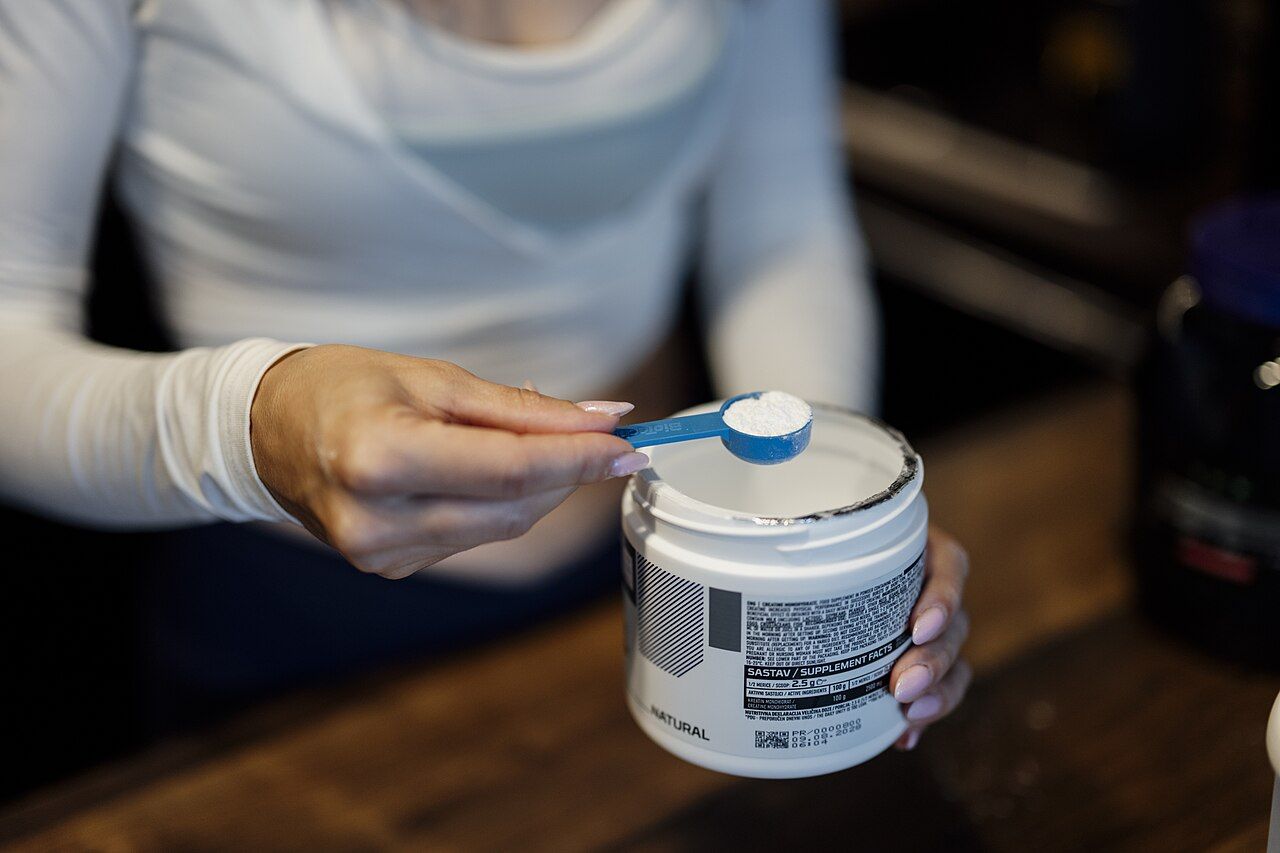
The most commonly studied supplement form, according to the ISSN, is creatine monohydrate. Red meat and supplements deliver the same molecule. The difference is dose. Reaching the 3 to 5 grams a day that the ISSN position stand says maintains muscle stores through food alone would take a lot of meat.
How does creatine work?
Muscle cells run on a molecule called ATP, which is used up within seconds during hard effort. Stored creatine, in the form of phosphocreatine, helps regenerate ATP quickly. More stored creatine means a little more fuel for short, intense efforts such as heavy lifting or sprints.
That is the mechanism. It explains why the effect shows up in brief, high-intensity work and not in long, easy endurance sessions.
What does the evidence show for exercise?
The International Society of Sports Nutrition reviewed the research in a 2017 position stand (Kreider et al., Journal of the International Society of Sports Nutrition). It concluded that creatine monohydrate is an effective supplement for increasing high-intensity exercise capacity and lean mass during training. It also found the supplement safe for healthy people at recommended doses.
The effects are modest. The position stand notes that vegetarians tend to start with lower muscle creatine stores and may see a larger rise in those stores when they supplement.
Does creatine help the brain?
Some researchers think so, since the brain also uses creatine for energy. A 2018 systematic review (Avgerinos et al., Experimental Gerontology) found some evidence that supplementation may improve short-term memory and reasoning in healthy people. The review covered six trials with 281 people in total, and the effect on other areas of thinking remained unclear.
Work on mood and depression is earlier still. Treat those findings as hypotheses, not recommendations.
What are the risks and side effects?
The most common complaint is temporary water retention and a bit of weight gain, mainly during a short high-dose "loading" phase, according to the ISSN. Some people report stomach upset; in one trial of soccer players, diarrhea was more common with a single 10-gram dose than with the same amount split into two 5-gram doses.
Creatine can also temporarily raise blood levels of creatinine, a waste product doctors use to estimate kidney function. A healthy person on creatine can look as if their kidneys are working poorly on a routine blood test, as one published case report described. Anyone who takes it should tell their doctor.
People with existing kidney disease, or who take medications that can harm the kidneys, should speak with a clinician before using it; a 2019 review advises against creatine for both groups. Supplements are also loosely regulated: the FDA does not approve dietary supplements before they are sold, so quality depends on the manufacturer.
Nothing here suggests creatine should replace any prescribed treatment.
Should you try it?
If the goal is better performance in strength training, creatine monohydrate is one of the few supplements with real evidence behind it. A common daily amount is 3 to 5 grams. The next step is to take your current medications and any kidney or liver history to your doctor or pharmacist and ask whether it fits.
This article is for general education only and is not medical advice. Talk to a doctor or other qualified health professional before changing your diet, supplements, medication, or treatment.
Sources
Kreider RB, et al. "International Society of Sports Nutrition position stand: safety and efficacy of creatine supplementation in exercise, sport, and medicine." Journal of the International Society of Sports Nutrition, 2017. https://pmc.ncbi.nlm.nih.gov/articles/PMC5469049/
Avgerinos KI, et al. "Effects of creatine supplementation on cognitive function of healthy individuals: A systematic review of randomized controlled trials." Experimental Gerontology, 2018. https://pubmed.ncbi.nlm.nih.gov/29704637/
Ostojic SM, Ahmetovic Z. "Gastrointestinal distress after creatine supplementation in athletes: are side effects dose dependent?" Research in Sports Medicine, 2008. https://pubmed.ncbi.nlm.nih.gov/18373286/
Refaie R, et al. "How we estimate GFR: a pitfall of using a serum creatinine-based formula." Clinical Nephrology, 2007. https://pubmed.ncbi.nlm.nih.gov/17969491/
Vega J, Huidobro E JP. "Effects of creatine supplementation on renal function." Revista Médica de Chile, 2019. https://pubmed.ncbi.nlm.nih.gov/31859895/
U.S. Food and Drug Administration, "Questions and Answers on Dietary Supplements." https://www.fda.gov/food/information-consumers-using-dietary-supplements/questions-and-answers-dietary-supplements
Our take
This take is opinion, not professional advice.
The Savvy Rabbits Staff
Our editors' take
We'd start where the article starts, with the mechanism. Muscle keeps phosphocreatine on hand to rebuild ATP in the first seconds of a hard effort, so the benefit belongs to a heavy set or a sprint, not a long, easy run. The 2017 position stand from Kreider and colleagues at the International Society of Sports Nutrition is the strongest evidence here. The brain case is thinner. The 2018 review by Avgerinos and colleagues covered six trials and 281 people; short-term memory and reasoning may improve, and everything else is unclear. Nobody should build a habit on that yet. The practical point is the blood test. Creatine can push up creatinine and make healthy kidneys look sluggish on paper. Tell whoever orders your blood work.